CfP: „Offen für alle? Zugang gestalten in den Digital Humanities“. Workshop der AG eHumanities, Berlin, 9.-10.11.2026

Entschuldigung aber dieser Post ist nur für angemeldete Benutzer sichtbar. Wenn Sie Mitglied der Digitalen Akademie werden und Zugang zu diesem Inhalt erhalten wollen, dann melden Sie sich bitte unter https://digitale-akademie.adw-goe.de/anmeldung/ bzw. im Menue Digitale Akademie > Anmeldung an. Sie werden dann nach Überprüfung umgehend einen Account erhalten und können die angefragten Seiten einsehen.

Bericht vom Treffen der Digitalen Akademie am 18.6.2026 🔒

Entschuldigung aber dieser Post ist nur für angemeldete Benutzer sichtbar. Wenn Sie Mitglied der Digitalen Akademie werden und Zugang zu diesem Inhalt erhalten wollen, dann melden Sie sich bitte unter https://digitale-akademie.adw-goe.de/anmeldung/ bzw. im Menue Digitale Akademie > Anmeldung an. Sie werden dann nach Überprüfung umgehend einen Account erhalten und können die angefragten Seiten einsehen.

Save the date: „Nachhaltigkeit und KI“: Zwischenbilanz der Göttinger Digitalen Akademie am 15.-16.10.26 (hybrid)

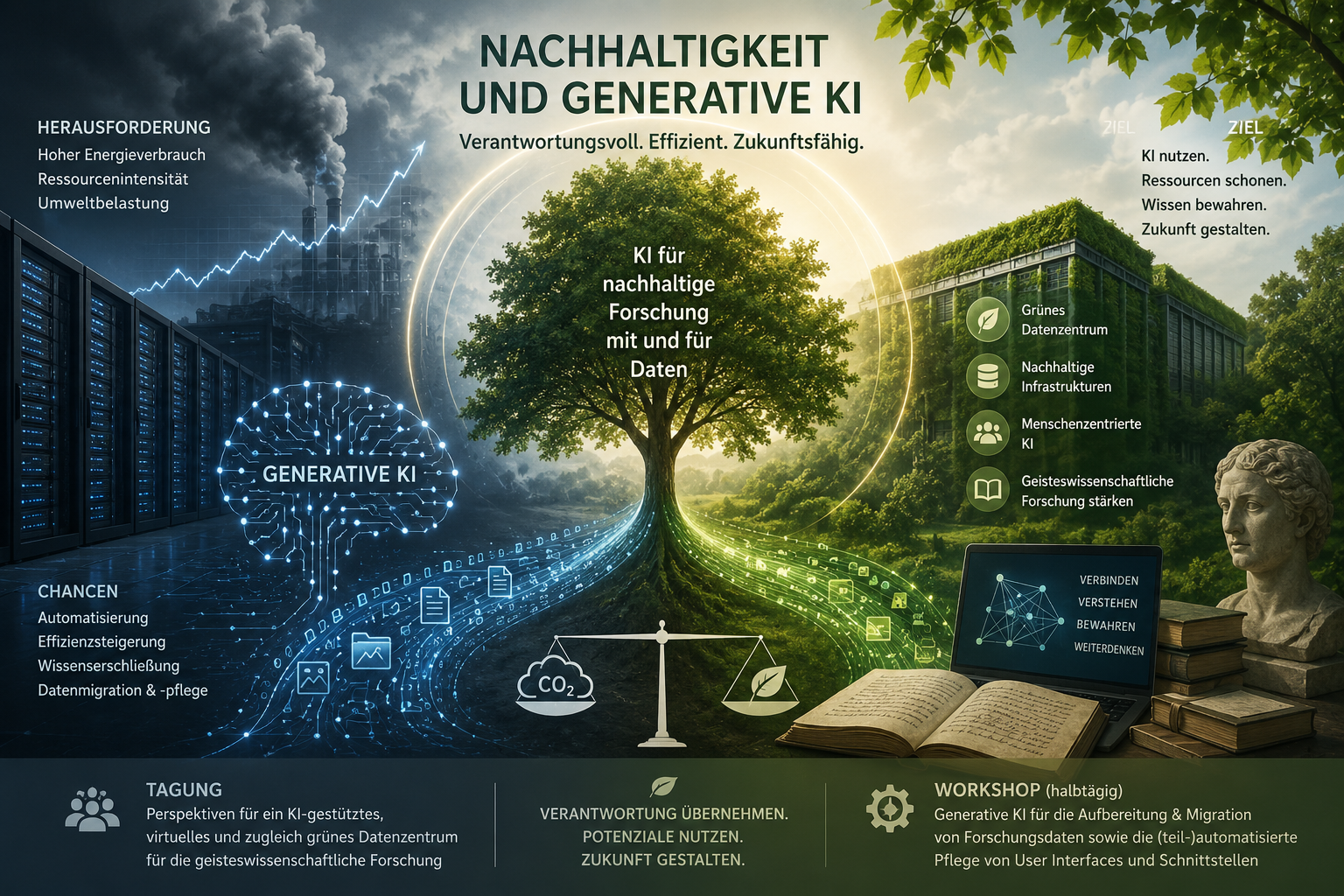
Nachhaltigkeit und KI sind zwei Schlagworte, die sich sowohl widersprechen als auch ergänzen. Der Energieverbrauch von KI-Rechenzentren scheint aktuell ins Grenzenlose zu steigen. Gleichzeitig  ermöglicht generative KI unter anderem die kostengünstige Pflege und Migration von  Forschungsdaten in Portalen und lebenden Systemen – und damit deren nachhaltige (Weiter-)Nutzung. Wie also umgehen mit dem scheinbaren moralischen Dilemma zwischen dem Wunsch nach nachhaltiger Software und (grüner) KI-Nutzung?
Wir  wollen auf dieser Tagung zugleich nach fünf Jahren Projektförderung Zwischenbilanz für die Arbeit der Göttinger Digitalen Akademie ziehen. Dabei sollen verschiedene Aspekte der Beziehung zwischen Nachhaltigkeit und generativer KI beleuchtet und Perspektiven für ein KI-gestütztes, virtuelles und zugleich grünes Datenzentrum für die  geisteswissenschaftliche Forschung und deren Daten entwickelt werden. Der Tagung vorgeschaltet  ist ein halbtägiger Workshop zum Einsatz generativer KI speziell für die Aufbereitung und Migration von Daten aus älteren Projekten sowie der (teil-)automatisierten  Pflege von User Interfaces und Schnittstellen „lebender Systeme“ (Referent: Christopher Pollin von DH-Craft). In Vorträgen aus der Perspektive der ForscherInnen sowie der infrastrukturbildenden Institutionen und auf einem Panel zum Thema „Nachhaltigkeit und KI – Technik, Ethik, Praxis“ wird die Frage der Beziehung zwischen Nachhaltigkeit und KI sowie der zukünftigen Nutzungsmöglichkeiten diskutiert.

Sprache: Deutsch und Englisch; Ort: Hybrid. Geiststrasse 10, Göttingen

Adressatenkreis:  MitarbeiterInnen aus den Akademienvorhaben der deutschen Wissenschaftsakademien,  weitere Gäste aus dem Göttingen Campus und darüber hinaus.

Abb: ChatGPT 5.2 – Nachhaltige KI und Forschung verbinden
Vorläufiges Tagungsprogramm:

(Alle Titel sind Arbeitstitel/Vorschläge)

15.10.26  Nachhaltigkeit und KI – ein spannungsreiches Verhältnis

09:00 – 12:30 Uhr – Workshop: How to use AI to maintain and preserve „living systems“ ? (Christopher Pollin, DH-Craft).

Mittagsimbiss

14:00 – 15:30 Uhr – Vorstellung von Projekten aus der Göttinger Digitalen Akademie  (GDA Team)

Kaffepause

16:00 – 16:30 Uhr – Vortrag: Perspektiven für ein nachhaltiges, KI-gestütztes geisteswissenschaftliches Datenzentrum (NHDC)

16:30 – 17:00 Uhr – Vortrag: Wie könnte KI und ihre Nutzung nachhaltig und grün werden?

17:15 – 18:30 Uhr – Panel-Diskussion: „Nachhaltigkeit und KI – Technik, Ethik, Praxis“  Moderation: Jörg Wettlaufer

19:00 – 22:00 Uhr – gemeinsames Abendessen auf Selbstzahlerbasis

16.10.26  Perspektiven der Nachhaltigkeit: Institutionen und ForscherInnen

09:00 – 10:30 Uhr –  3 Vorträge „Perspektiven der Nachhaltigkeit – Sicht der Institutionen“

11:00 – 12:30 Uhr – 3 Vorträge „Perspektiven der Nachhaltigkeit – Sicht der ForscherInnen“

Mittagsimbiss, anschließend Rückreise

Anmeldungen bitte mit diesem Formular. Mit Absenden des Formulars stimmen Sie der Verarbeitung der Daten durch die NAWG zu. Die Daten werden ausschliesslich zur Organisation der Tagung verwendet.

Für Nachfragen zur Tagung wenden Sie sich bitte an Dr. Jörg Wettlaufer: joerg.wettlaufer@adwgoe.de

Bericht vom Treffen der Digitalen Akademie am 16.4.2026 🔒

Entschuldigung aber dieser Post ist nur für angemeldete Benutzer sichtbar. Wenn Sie Mitglied der Digitalen Akademie werden und Zugang zu diesem Inhalt erhalten wollen, dann melden Sie sich bitte unter https://digitale-akademie.adw-goe.de/anmeldung/ bzw. im Menue Digitale Akademie > Anmeldung an. Sie werden dann nach Überprüfung umgehend einen Account erhalten und können die angefragten Seiten einsehen.

Bericht vom Treffen der Digitalen Akademie am 22.1.2026 🔒

Entschuldigung aber dieser Post ist nur für angemeldete Benutzer sichtbar. Wenn Sie Mitglied der Digitalen Akademie werden und Zugang zu diesem Inhalt erhalten wollen, dann melden Sie sich bitte unter https://digitale-akademie.adw-goe.de/anmeldung/ bzw. im Menue Digitale Akademie > Anmeldung an. Sie werden dann nach Überprüfung umgehend einen Account erhalten und können die angefragten Seiten einsehen.

NFDI4Memory: FAIR Data Fellowship Ausschreibung & Infoveranstaltung am 4.11.2025

[Crossposting von der AG_digigw-Liste]

Ihr habt Forschungsdaten erhoben für ein geschichtswissenschaftliches Projekt, aber sie schlummern ungenutzt auf externen Festplatten oder in irgendeinem Unterordner?

Für alle, die das ändern möchten, gibt es die NFDI4Memory FAIR Data Fellowships.

Die bis zu elf Fellows arbeiten ihre historischen Forschungsdaten mit Beratung von Expert:innen im Forschungsdatenmanagement bis zur Publikation auf.

Die einmonatigen Fellowships sind mit je 1.500,- Euro dotiert und können remote stattfinden. Sie richten sich an alle Historiker:innen und historisch Arbeitenden egal mit welchen Vorkenntnissen – entscheidend ist die Motivation, die eigenen historischen Forschungsdaten aktiv mit der Community teilen zu wollen.

Bewerbungsfrist ist der 19.11.2025 – internationale Bewerbungen sind willkommen! Weitere Informationen zur Ausschreibung: https://4memory.de/fileadmin/files/Calls/Fellowships/Ausschreibung_2026_dt.pdf

Für alle Kurzentschlossenen: Heute, Di. 04.11.2025, findet um 14 Uhr eine online Informationsveranstaltung zu den FAIR Data Fellowships und der aktuellen Ausschreibung statt. Der Zugang erfolgt ohne Voranmeldung über Zoom.

Weiter Informationen zu den NFDI4Memory FAIR Data Fellowships auch auf unserer Website: https://4memory.de/aktivitaeten/fellowships/

Herzliche Grüße aus dem NFDI4Memory Coordination Office!

P.S.: Eventuellen Mehrfachempfang bitten wir zu entschuldigen.


NFDI4Memory Coordination Office

M 4memory@ieg-mainz.de

Leibniz-Institut für Europäische Geschichte (IEG)
Alte Universitätsstr. 19
55116 Mainz Germany
4memory.de
CFP DH2026 in Daejeon, Südkorea. Deadline 8. Dezember 2025

Call for Proposals

The Alliance of Digital Humanities Organizations (ADHO) invites submissions for its annual conference, DH2026, to be held in Daejeon, South Korea, from July 27 to 31, 2026.

Conference Theme: „Engagement“

Our theme, “Engagement,” highlights our commitment to fostering meaningful connections—both among diverse communities and between humans and emerging technologies. It emphasizes vibrancy in community interactions and critical reflection on technologies such as “Artificial Intelligence” and their responsible applications. The increasing prominence of generative AI technologies—including large language models, multimodal systems, and computer vision models—invites fresh perspectives and re-examinations of practices across the digital humanities, from data analysis and modeling to heritage studies and beyond. This conference embraces both established areas of digital humanities and emerging approaches, encouraging discussions that critically and practically examine these technological developments and consider their impacts within the communities and contexts they shape.

The three sub-themes outlined below are intended as illustrative examples to guide proposals, rather than as strict limitations on the scope of contributions.

Translating | Translinguality in the Era of AI

Machine translation using AI is becoming more sophisticated than ever. These developments not only accelerate translation and cultural exchange across languages—often without passing through English—but also expand the contact zone between humans and machines. Alongside this, the increasing integration of multilingualism into AI systems reflects a broader shift toward accommodating linguistic diversity across platforms, interfaces, and modes of communication. Meanwhile, research on cultural translation has evolved—from emphasizing fidelity and textual originality to focusing on the situatedness of translation and the politics of language hierarchies. How, then, might AI-driven translation technologies reshape the implications of “translingual practice”? And as a testbed, what possibilities and challenges does the use of AI translation in international scholarly events like DH2026 present?

Annotating | Beyond Patterns: Interpretation with Small Data

The Digital humanities have primarily explored the patterns of change in humanities using big data. However, must this data necessarily be “big”? Should the results of such analysis always reveal patterns? How should we address algorithmic bias and discrimination inherent in data collection and analysis? If we acknowledge that data itself constitutes historical and social artifacts, we may become more consciously aware of the process of producing research. Small-scale datasets can support more nuanced interpretation, and such perspectives can also inform AI model training, particularly in shaping practices for under-resourced languages or specialized domains. How can we generate high-quality data on a smaller scale, and how can we use such data to conduct research that remains open to interpretation? Could this understanding of data influence the way AI models are trained and structured?

Remembering | Digital Humanities and the Memory of the World

UNESCO’s Memory of the World register aims not only to preserve, but also to advance interest in and understanding of precious archival documents of historical and cultural value to humanity. These documents are not mere artifacts locked away in a secluded archive, but are source materials which continue to serve as primary texts for humanities research today. This sub-theme invites reflection on questions of ownership, curation, and purpose, including considerations of Indigenous Data Sovereignty: whose memories are preserved, and for whose benefit? It also encourages critical engagement with emerging digital tools, including large-scale AI systems describable as “memory machines,” examining how such technologies interact with and reinterpret these cultural memories. By highlighting contributions from diverse countries and exploring innovative methodologies rooted in digital humanities, this sub-theme seeks to enhance interpretation, access, and engagement with these invaluable resources.

Call for Submissions

We welcome submissions on a broad range of topics within the field of digital humanities, extending beyond the themes outlined above.

Languages

Proposals are requested to be submitted in English to ensure adequate peer review. Authors will be asked to indicate their preferred presentation language at the time of submission. While accommodating multiple languages in a hybrid international conference presents challenges, the Local Organizers and Program Committee will make every effort to respect these preferences and organize the conference accordingly. In line with the conference theme of “Engagement,” KADH plans to introduce an AI-powered translator during conference presentations to support both linguistic inclusivity and engagement with technological challenges. Presenters who prefer not to have their presentations AI-translated will have the option to opt out, and will give their presentation in English.

Technical Track

Authors may designate their submission as part of the Technical Track. Submissions in this track, in line with the mission of the DHTech SIG, emphasize the development, sustainability, and reuse of software and infrastructures for the digital humanities. These proposals will be reviewed by members of the DHTech SIG.

This process is being formalized for DH2026 in consultation with the DHTech SIG, and submissions following this designation will benefit from the SIG’s expertise in evaluating technical work.

Conference Formats

Proposals may be submitted for the following formats:

  • Long papers (Abstracts should be 1250-1500 words): Suited for substantial, completed, and previously unpublished research; reports on developing significant new methodologies or digital resources; and/or rigorous theoretical, speculative, or critical discussions. Presentations are typically 20 minutes.
  • Short papers (Abstracts should be 750-1000 words): Appropriate for reporting on experiments, work in progress, and newly conceived tools or software in early stages of development. Presentations are typically 10 minutes.
  • Posters (Abstracts should be 500-750 words): For presenting work on any relevant topic, or offering demonstrations of projects, tools, artwork, creative visualizations, and software in various stages of development.
  • Pre-conference Workshops or Mini-conferences: See Below
  • Note that ADHO no longer accepts panel proposals.

Pre-conference Formats

  • Workshops are intensive introductions to specific techniques, software packages, or theoretical approaches. Workshops last half a day and can be held in person or online. Proposals should include an agenda (focusing on learning outcomes, target audience, and instructor expertise). The abstract should be 1000 words.
  • Mini-conferences are day-long gatherings that do not fit the workshop format. For example, a mini-conference could be a THATCamp, hackathon, maker faire, or a series of events at a local venue. The abstract should be 1000 words. 

Special Interest Group Proposals

There are currently ten recognized ADHO special interest groups (SIG). Each SIG may organize one guaranteed pre-conference activity, either as a half-day workshop or as a half-day mini-conference. These program elements are guaranteed acceptance. SIGs must notify the program committee that they intend to organize a workshop or mini-conference prior to the conference submission deadline. We ask the SIGs to contact the program committee via kadh2026+pc@gmail.com.

Note on Review Expectations

As an interdisciplinary and international conference, scholars come to DH from a wide range of disciplinary and cultural contexts. As a result, it is not uncommon for there to be some degree of confusion regarding the expectations for submissions. Proposals for the DH conference are expected to be “abstracts” of the presentation to be given, with different formats offered for work at different stages of completeness.

Please note that, for all submission types, authors are expected to include a literature review (with citations) in order to situate the work within the relevant disciplinary context and ground the scholarly contribution of the work. In addition, for long papers, while authors can submit proposals on work nearing completion, the research should be sufficiently completed for authors to speak to major findings and the scholarly significance of the results in their proposals. Work where the outcomes are still anticipated are better suited for the short paper or poster formats.

Important Dates

  • Submissions Accepted From: October 8, 2025, 00:00 AM KST
  • Deadline for Submissions: December 8, 2025, 11:59 PM KST
  • Notification of Acceptances: mid-February, 2026 [TBA]
  • Registration Open: mid-February, 2026 [TBA]

Submission Portal

Proposals must be submitted via ConfTool: https://www.conftool.pro/dh2026/

Hybrid Conference Model

DH2026 is planned as a hybrid conference. Accepted authors will be asked their preference to attend in-person or online for scheduling purposes. We aim to facilitate meaningful participation for both in-person and remote attendees.

Review Process and Criteria

Submissions will undergo a double anonymous (blind) review process. Thus, authors’ and reviewers’ identities will not be disclosed. This also means that submissions should not contain any information which would serve to identify the authors.

Reviewers will assess proposals based on ADHO’s established criteria as follows

  • [1, 20%] Does the submission include a sufficient description of the current state of knowledge and best practices in the area(s) relevant to the work, and is that description backed up by useful references?
  • [2a, 20%] Does the work described in the submission go beyond the current state of knowledge and best practices in the areas(s) relevant to the work? This may concern method, approach, application domain, or findings.
  • [2b, 20%, workshops] Does the submission describe the contents of the workshop (topics, issues, methods, tools) in sufficient detail for readers to understand what will be taught?
  • [3a, 20%] Does the submission describe its approach or method with sufficient detail for readers to understand what was done and why it was done, within the limitations of the abstract format?
  • [3b, 20%, workshops] Does the submission describe its didactical approach, the materials to be used, and the progression of topics over the course of the workshop with sufficient detail for readers to understand how the workshop will be taught?
  • [4, 15%] Does the submission support diversity, in the sense that it describes work that increases the range of topics, approaches and perspectives presented at the DH conference, and/or does it give adequate recognition to a broad range of relevant scholarly work, including by members of disadvantaged or under-represented groups?
  • [5, 15%] Is the submission well-structured and clearly written in a way that supports readers in understanding the submission?

Contact

For inquiries, please visit the conference website (https://dh2026.adho.org/) or contact kadh2026@gmail.com.

We look forward to your contributions and to welcoming you to Daejeon!